
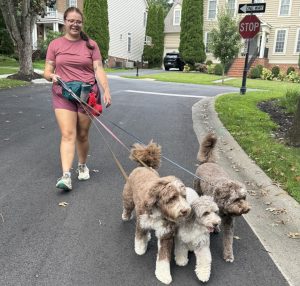
How to Choose a Dog Walker in Gaithersburg
How to choose a dog walker in Gaithersburg: what actually matters
Hiring someone to walk your dog means handing over a key, a routine, and a living creature you’re responsible for, so it’s worth doing more than a quick search and picking whoever answers first. If you’re comparing dog walkers in Gaithersburg or the surrounding Montgomery County area, here’s what actually separates a good choice from a risky one. Knowing how to choose a dog walker in Gaithersburg comes down to a handful of concrete questions, not gut feeling or whoever shows up first in a search.
Insurance isn’t optional
This is the first thing to ask about, not the last. If your dog is injured, causes property damage, or gets into an incident during a walk, an insured walker protects you from out-of-pocket costs. An uninsured walker, however friendly or well-reviewed, is a real financial and liability risk you’re taking on yourself. Ask directly whether a walker carries liability insurance and whether they’re bonded, and don’t treat “I’ve never had a problem” as a substitute for actual coverage.
Ask how they’d handle an emergency, not just a walk
A good way to separate a prepared professional from someone winging it: ask what they’d do if your dog got hurt on a walk. Someone experienced will name your vet, describe exactly how they’d reach you, and walk through basic first steps without hesitating. A vague or uncertain answer is worth paying attention to.
Vaccination requirements are part of this too. A walker who asks for proof of current vaccinations before the first visit isn’t being bureaucratic, they’re protecting every dog in their care, including yours, from exposure to things like kennel cough or parvovirus during group or neighborhood walks. We require current vaccinations for every dog we walk, for exactly this reason.
Group size and individual attention
Some walkers take out several dogs at once to cover more ground; others keep walks solo or in small numbers. Neither is automatically wrong, but a smaller group means more individual attention, a faster response if your dog needs something, and less risk of a dog-on-dog conflict. If your dog does better with less chaos around them, ask directly how many dogs a walker typically brings on a single walk, and whether that number is fixed or flexible.
What “reliable” actually means
Reviews and reputation matter, but reliability is really about what happens on the days things don’t go as planned. Ask any prospective walker two questions: what’s your cancellation policy, and what happens if you’re sick or on vacation? A professional setup has a real answer, not a shrug. At OBH, when a regular walker is out, another trained member of our team steps in rather than leaving a gap in your dog’s routine, so a single person’s schedule never becomes your problem.
If your schedule requires the same time slot every weekday, ask whether that’s genuinely protected or just usually available. A walker with too large a roster may not be able to guarantee it.
Compare price the right way
Don’t compare headline rates alone. A lower price sometimes reflects the absence of insurance, training, or a real business structure, costs a responsible walker builds into their pricing rather than skips. Convert every pricing structure, whether it’s per-walk, hourly, or a monthly package, into a cost per walk so you’re actually comparing like with like, and ask whether a package includes make-up walks for cancellations.
The more useful question isn’t “who’s cheapest,” it’s “what’s actually included.” Insurance, GPS tracking, post-walk updates, and flexibility around your schedule are all things that justify a higher rate when they’re real, not just marketing language.
Communication you can actually verify
Some walkers text updates only when there’s a problem; others send a note or photo after every visit. Most owners find regular, brief confirmation reassuring rather than excessive, since it turns “I assume everything’s fine” into “I know everything’s fine.” A system that logs when your walker actually arrived and left, rather than relying on memory or a quick text, gives you something verifiable. We log every visit through Time To Pet with GPS-tracked routes, so you can see exactly when we showed up, where we walked, and how the visit went, not just take our word for it.
The meet-and-greet is not a formality
Before your dog is out on a public street with someone new, that person should meet them first. A proper meet-and-greet lets a walker learn your dog’s personality, routine, and any specific needs before they’re responsible for them outside your home. A walker who skips this step is taking on a job without the information they need to do it safely. Treat a meet-and-greet as a baseline expectation, not an extra.
Bringing it together
When you know how to choose a dog walker in Gaithersburg using these criteria, the decision gets a lot less overwhelming. None of these factors matter in isolation. Insurance without reliability doesn’t help you on the day your regular walker calls in sick. A great price without real coverage or communication can turn into the most expensive option if something goes wrong. The right dog walker for your family is the one who can answer all of these questions clearly and specifically, not just the one with the most reviews or the lowest rate. Learning how to choose a dog walker in Gaithersburg really comes down to a few honest questions, not hoping for the best.
If you’re weighing your options in Gaithersburg, Potomac, Kentlands/Lakelands, or anywhere else in Montgomery County, we’re happy to walk through exactly how we handle insurance, backup coverage, and day-to-day communication so you can compare us against anyone else you’re considering.
Trackbacks/Pingbacks